


History of Black People and Watermelon 🍉
- Naquasia Boyd
- Sep 29, 2020
- 5 min read
Updated: Sep 29, 2020
Did you know the watermelon is from Africa? Or that it’s actually a berry? And that they’re delicious AF? Yet given its history via racist white America, the watermelon can be triggering for black folks.
The watermelon, indigenous to northeastern Africa, started as Citrullus lanatus var. colocynthoides 5,000 years ago. Then, it was a treat that many enjoyed and it even found its way into the hieroglyphics in King Tut’s tomb.

But the trope of black people and watermelon came about when slaves won their freedom. Many free black people used watermelons to make money. But their old massas didn’t like their newfound freedom. So what did they do? They took the watermelon and made it a symbol for lazy, dirty black people.
How? Well, lazy, because it’s easy to grow watermelons and it’s a cumbersome thing to eat, so you can’t work while eating it. You have to sit down. And dirty? Well, watermelons make huge messes and leave rinds that were often scattered all over the ground.
The watermelon was made a disgrace by those hatin’ ass racists and that label stuck.

And while many of us enjoy watermelon, when you’re black, it can indeed be triggering.
While mainstream-media figures deride these instances of racism or at least racial insensitivity, another conversation takes place on Twitter feeds and comment boards: What, many ask, does a watermelon have to do with race? What’s so offensive about liking watermelon? Don’t white people like watermelon too? Since these conversations tend to focus on the individual intent of the cartoonist, coach, or emcee, it’s all too easy to exculpate them from blame, since the racial meaning of the watermelon is so ambiguous. But the stereotype that African Americans are excessively fond of watermelon emerged for a specific historical reason and served a specific political purpose. The trope came in full force when slaves won their emancipation during the Civil War. Free black people grew, ate, and sold watermelons, and in doing so made the fruit a symbol of their freedom. Southern whites, threatened by blacks’ newfound freedom, responded by making the fruit a symbol of black people’s perceived uncleanliness, laziness, childishness, and unwanted public presence. This racist trope then exploded in American popular culture, becoming so pervasive that its historical origin became obscure. Few Americans in 1900 would’ve guessed the stereotype was less than half a century old.
Not that the raw material for the racist watermelon trope didn’t exist before emancipation. In the early modern European imagination, the typical watermelon-eater was an Italian or Arab peasant. The watermelon, noted a British officer stationed in Egypt in 1801, was “a poor Arab’s feast,” a meager substitute for a proper meal. In the port city of Rosetta, he saw the locals eating watermelons “ravenously … as if afraid the passer-by was going to snatch them away,” and watermelon rinds littered the streets. There, the fruit symbolized many of the same qualities as it would in post-emancipation America: uncleanliness because eating watermelon is so messy.
Laziness, because growing watermelons are so easy, and it’s hard to eat watermelon and keep working—it’s a fruit you have to sit down and eat. Childishness, because watermelons are sweet, colorful, and devoid of much nutritional value. And unwanted public presence, because it’s hard to eat a watermelon by yourself. These tropes made their way to America, but the watermelon did not yet have a racial meaning. Americans were just as likely to associate the watermelon with white Kentucky hillbillies or New Hampshire yokels as with black South Carolina slaves.
Soon after winning their emancipation, many African Americans sold watermelons in order to make a living outside the plantation system.

(Frank Leslie’s Illustrated Newspaper, African America selling watermelon )
This may be surprising, given how prominent watermelons were in enslaved African Americans’ lives. Many slave owners let their slaves grow and sell their own watermelons, or even let them take a day off during the summer to eat the first watermelon harvest.
The slave Israel Campbell would slip a watermelon into the bottom of his cotton basket when he fell short of his daily quota, and then retrieve the melon at the end of the day and eat it.

Campbell taught the trick to another slave who was often whipped for not reaching his quota, and soon it was widespread. When the year’s cotton fell a few bales short of what the master had figured, it simply remained “a mystery.”
Oh, this is fucking great… Have you ever seen a movie with some little joke about watermelon that you didn’t understand? A meme on the Internet you just didn’t get? (Take a look, there’s plenty.)
Well, watermelon didn’t exist in America before the period of slavery because watermelon is a fruit that comes from southern Africa. It was the enslaved blacks that brought the watermelons over and they were usually the ones who ate it.

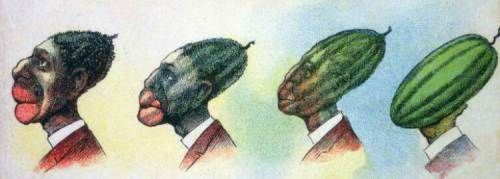
Watermelon was widely used in racist and stereotypical iconography of the black during the Post-Reconstruction era — in products, caricatures, and representations where the black was a watermelon-crazy nut, capable of dropping everything if you tossed some watermelon in front of him.
Racists generally use the term “nigger bait” to talk about the fruit.
In 1970, for example, they made a film based on The Metamorphosis, by Franz Kafka, where a white racist wakes up and discovers that he’s turned into a black man. The film, without the slightest subtlety, tries to be an anti-racist film, where a white racist discovers “in the flesh” all the evil that racism causes, and was so careful and soooooo respectful to black people that it was given the suuuuper sensible title The Watermelon Man.
At the end of the film the protagonist becomes black forever, is abandoned by family and friends because of his color, and becomes a pastiche of an Angry Black Man, that jumpy black dude jivin’ around and walking the streets making trouble for everyone…hell of a life lesson, right?
For decades, Disney has been criticized for its lack of black characters, and in 2009 they finally released a film with the legendary “first black princess”, Tiana. When they created the marketing campaign, just guess what flavor of candy was reserved for her, while Princesses like Aurora and Belle were given the flavor vanilla?????????
And that my friends, caused a bit of trouble…

Since the late 80s, it’s almost become common sense that showing blacks eating watermelon in the media is politically incorrect, and if you insisted on it, you’d end up buying more trouble than you really want. So, many believed that this was an extinct stereotype, until the marvelous appearance of our beloved internet, which reacted to the election of a candidate named Barack Obama with countless memes and discussions where the watermelon cliché was used to offend, showing that on the Internet this racist stereotype is alive and well. Feel free to toss it up there on the google, but this time I’ll pass.


Comments